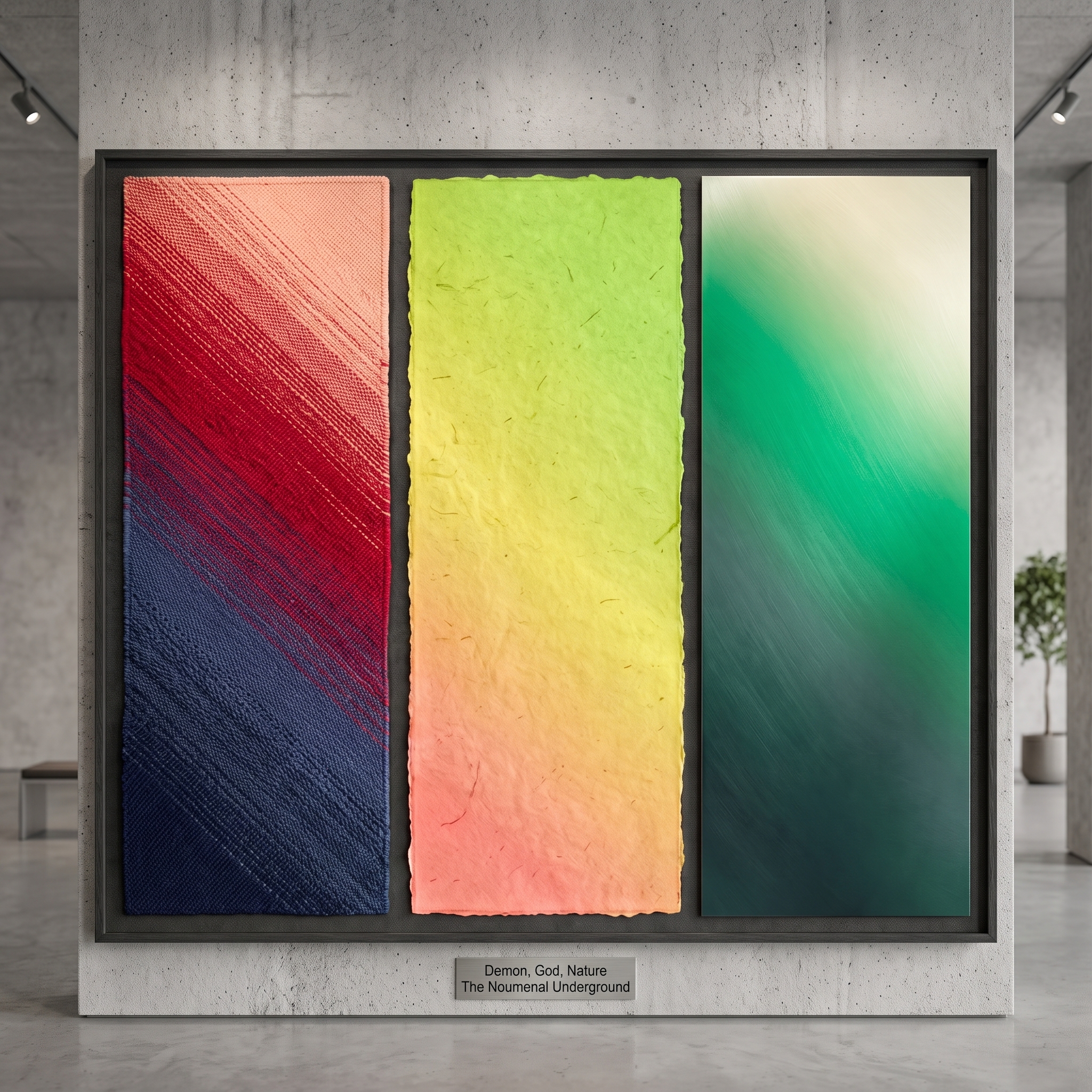
Welcome back to the Underground.
Our fourth full-length record is live. For three albums we lived in the ancient world — the raw cosmos, the streets of Athens, the collapse of the Hellenistic fringes. Demon, God, Nature jumps roughly seventeen hundred years forward and lands in a cold room in the Netherlands, where a man has decided to stop believing anything at all.
The Premise
The early modern period is the century where European thought took itself apart and tried to rebuild from nothing. Descartes starts it by doubting the existence of his own hands. What follows is a chain of people trying to put the world back together and each producing something stranger than the last — a sovereign made of its own subjects, a God identical with nature, a universe where nothing causes anything, a mind that begins as a blank sheet, monads with no windows, matter that turns out to be perception, a self that turns out to be nobody.
We built the record so they can hear each other. Track two states the case for absolute sovereignty; track nine is the reply, written a century later, and it lands as an accusation. Track six ends by insisting that removing a single sorrow would make the whole world worse; track ten is named to answer it directly. This is the first album where the sequencing carries an argument rather than a theme.
Side One
“I Think Therefore I Am … Tired“ opens the record with Arthur Kings alone and deeply over it. The whole apparatus of radical doubt, delivered by a man who mostly wants to go to bed. Six meditations in three and a half minutes, over Elias Li’s electric guitar and Reggie Olsen’s keys.
“The Mortal God“ is Hobbes, and it’s the Leviathan itself doing the talking — recruiting in the first half, demanding in the second. Patty Alex’s cello and Clara Max’s winds give the march its weight. Listen for what the sovereign concedes at the very end: the right to defend your own life, and the fact that your inward belief was never his to command.
“A Proposition: Deus sive Natura“ hands Clara the lead for the coldest, most rigorous track we have ever recorded. Definitions, demonstration, corollary, scholium. Martin Black’s drum machine keeps the geometric order.
“Empty Occasion“ is our favourite thing on the album. Elias sings a cheerful little song about having a really nice morning, and every causal claim in it gets quietly withdrawn as it’s made. The sun doesn’t warm your face. Your legs don’t move because you willed them to. Acoustic guitar, glockenspiel, and a worldview with the engine taken out.
“The Understanding“ is Locke, and it’s the most densely packed lyric we have written — porphyry in the dark, the pineapple, Molyneux’s blind man, the prince and the cobbler, the elephant and the tortoise. It ends on a needle dropping into a groove.
Side Two
“The Best of All Possible Worlds“ is Leibniz, and Elias sings it as consolation rather than as lecture. The last verse names the date of the Lisbon earthquake and counts the years remaining. Forty. Everything on this track is set up to be destroyed by the closer.
“Esse est Percipi“ gives Reggie the lead over Clara’s winds and Martin’s programming. Berkeley is the most misunderstood man on this record — everyone thinks he denied the external world, and he thought he was rescuing it. The track ends by turning the doctrine on the listener.
“Nobody In Me (Bundle of Perceptions)” is Hume, and it’s the only song we know of that’s cheerful about the disappearance of the self. He burns every philosopher who came before him on the record, applies the same test to himself, finds nobody home, and goes to dinner. Dave Edins and Patty carry it. The bridge is the one place the shrug stops working.
“The Fruits Belong to Everyone“ is Rousseau complaining to a friend over a drink. Reggie takes the lead. Seven grievances, all of them small, all of them about somebody having a claim on something that should be nobody’s. The last thing he admits is that he has a fence of his own.
“The Best of All Worlds“ closes the album with Voltaire. Elias sings a catalogue of catastrophe — the gauntlet, Lisbon, the auto-da-fé, the maimed man at Surinam — and at the end, Pangloss makes the argument from track six one final time. Candide doesn’t refute it. He says it’s well put and goes outside to work.
Where to Start
If you want the record’s cold, structural heart, start with “A Proposition“ or “The Mortal God.” If you want to understand why we made it, start with “Empty Occasion“ — a sweet little tune about a world where nothing can touch anything else. And if you only listen to one, make it “The Best of All Worlds.” Ten tracks of people explaining the universe, and the last one stops.
One More Thing
Four albums now named after Kant’s distinction between the noumenal and the phenomenal, and he still hasn’t appeared on a single track.
That changes next.
Welcome to the Underground.
Leave a Reply