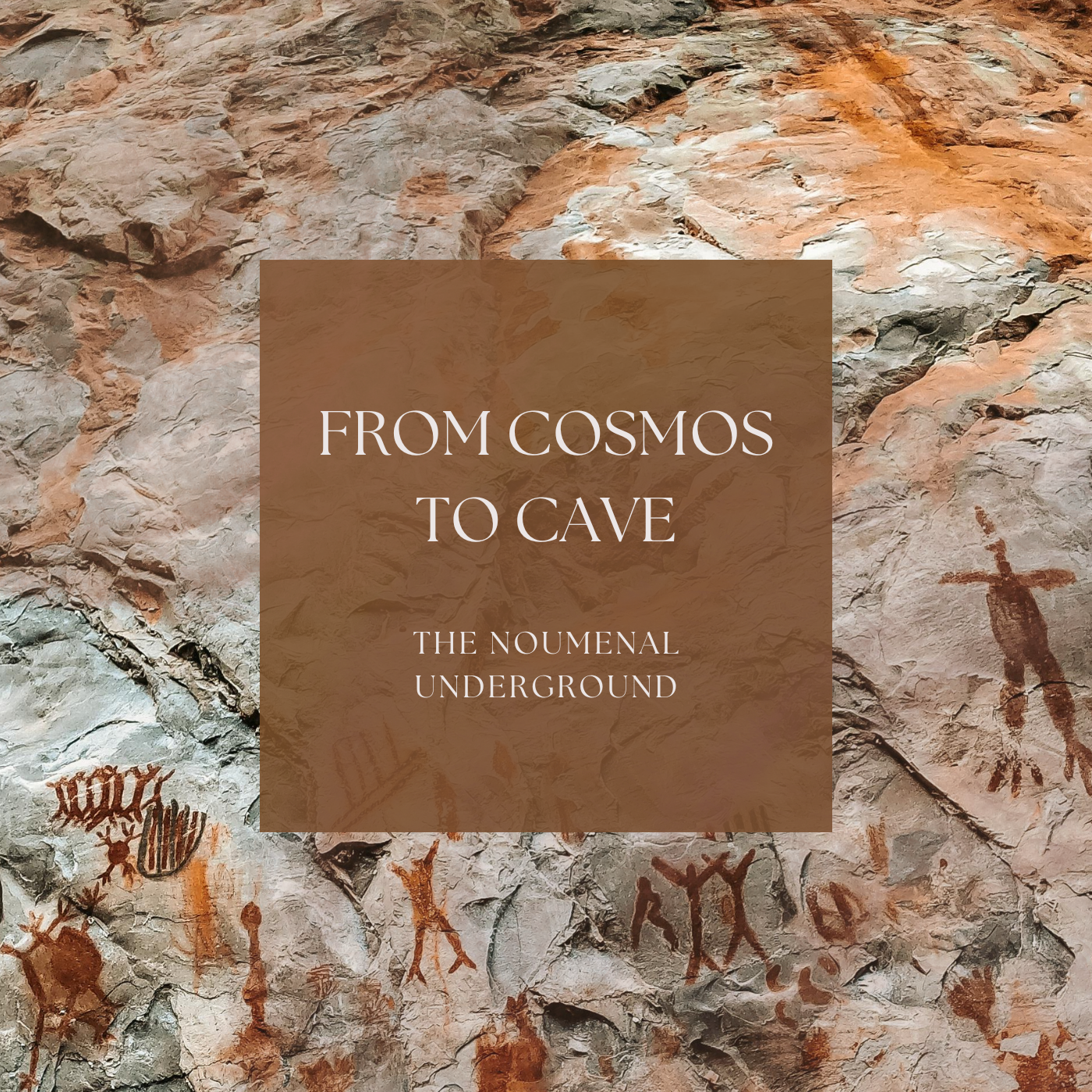
Welcome back to the Underground.
When we wrapped up our debut album, First Principles, we had spent months drowning in the raw, elemental noise of the Pre-Socratics. It was heavy, it was distorted, and it was entirely focused on the chaotic building blocks of the universe. But for our sophomore record, From Cosmos to Cave, we knew we had to pivot. We were tracking the exact moment philosophy moved out of the wild and into the city streets of Athens.
The sound had to evolve. We traded the pure sonic destruction for complex, dramatic, and deeply human arrangements. This record is about Socratic inquiry, Platonic idealism, and the dawn of Western logic.
Here is a behind-the-scenes look at how we built the city of Athens, track by track.
1. Apeiron (The Infinite Deep) We open in the boundless, undefined void of Anaximander’s Apeiron. Rather than hitting you with a wall of sound right out of the gate, we wanted this track to feel massive but formless. Clara steps up with haunting lead vocals, while Reggie layers atmospheric keyboards over Martin’s driving drum machine. Anchored by Ben on bass and Dave on the kit, the track slowly takes physical shape out of the darkness.
2. Engine of the Cosmos (Aer) Next, we tackle Anaximenes’ theory of air as the primary substance. This track needed to breathe. Reggie takes over lead vocals alongside a standout, breathy saxophone performance by Clara. The rhythm section locks into a steady, pulsing groove, giving physical, musical form to the invisible atmospheric forces that surround us.
3. If a Horse Could Hold a Pen A sharp pivot to Xenophanes’ brilliant critique of human-made gods. We completely stripped away the electronics here, leaning heavily into a raw, acoustic arrangement. Elias shines on acoustic guitar, paired beautifully with sweeping violin from Patty. Arthur delivers the pointed, cynical vocals, mocking humanity’s tendency to create deities in its own image.
4. Nous (The Master Knows) Channeling Anaxagoras’ concept of the cosmic mind (Nous), this is where the band flexes its heavy rock muscles. Reggie fires up the electric organ while Elias switches over to electric guitar. Arthur provides the commanding lead rock vocals, supported by the deep, rich resonance of Patty’s cello to create an incredibly dense and complex arrangement.
5. Cut it in Half (We Ain’t Goin’ Nowhere) Zeno’s paradoxes of motion get a glitchy, mechanical treatment. Driven entirely by Reggie’s synthesizers and Martin’s programmed beats, Patty steps up to the mic for a vocal track that stutters, stops, and loops. It perfectly mimics the mathematical nightmare of moving forward but never actually arriving anywhere.
6. Ode to Eros (Symposium) The album officially shifts into Plato’s dialogues. “Ode to Eros” pulls back the production for a gorgeous, intimate exploration of love. Arthur leads the vocals with Patty providing lush background harmonies. Accompanied by Elias’s acoustic guitar and delicate wind instruments from Clara, it is one of the most organic moments on the record.
7. Prehistoric Spark (Meno) Exploring Plato’s theory of recollection—the idea that all learning is just the soul remembering what it already knows. Patty takes the lead vocals, backed by Elias’s harmonies and Reggie’s soaring electric organ. Ben and Dave drive a hypnotic, circular beat as the song attempts to “remember” its own melody.
8. Pick a Horn (Euthyphro) A synth-heavy, pulsating track dissecting the famous Euthyphro dilemma. Elias delivers incredibly soulful lead vocals over Reggie’s synthesizers and Martin’s drum machine, asking the unanswerable question: Is a thing good because the gods love it, or do the gods love it because it is good?
9. I am the Gadfly (Apology) Socrates on trial. This track brings back the raw, distorted rock energy of our debut. Arthur spits defiant, unapologetic vocals against the backdrop of Elias’s heavy electric guitar and a relentless rhythm section powered by Martin. It is the aggressive sound of a philosopher choosing the hemlock over silence.
10. Form of the Good The culmination of Platonic idealism. For the finale, the physical rhythm section completely drops out. Clara delivers ethereal vocals over Reggie’s soaring synthesizers and Martin’s final drum programming. It represents the ultimate ascension—leaving the shadows of the cave behind and stepping into the pure, blinding light of the Forms.
Leave a Reply